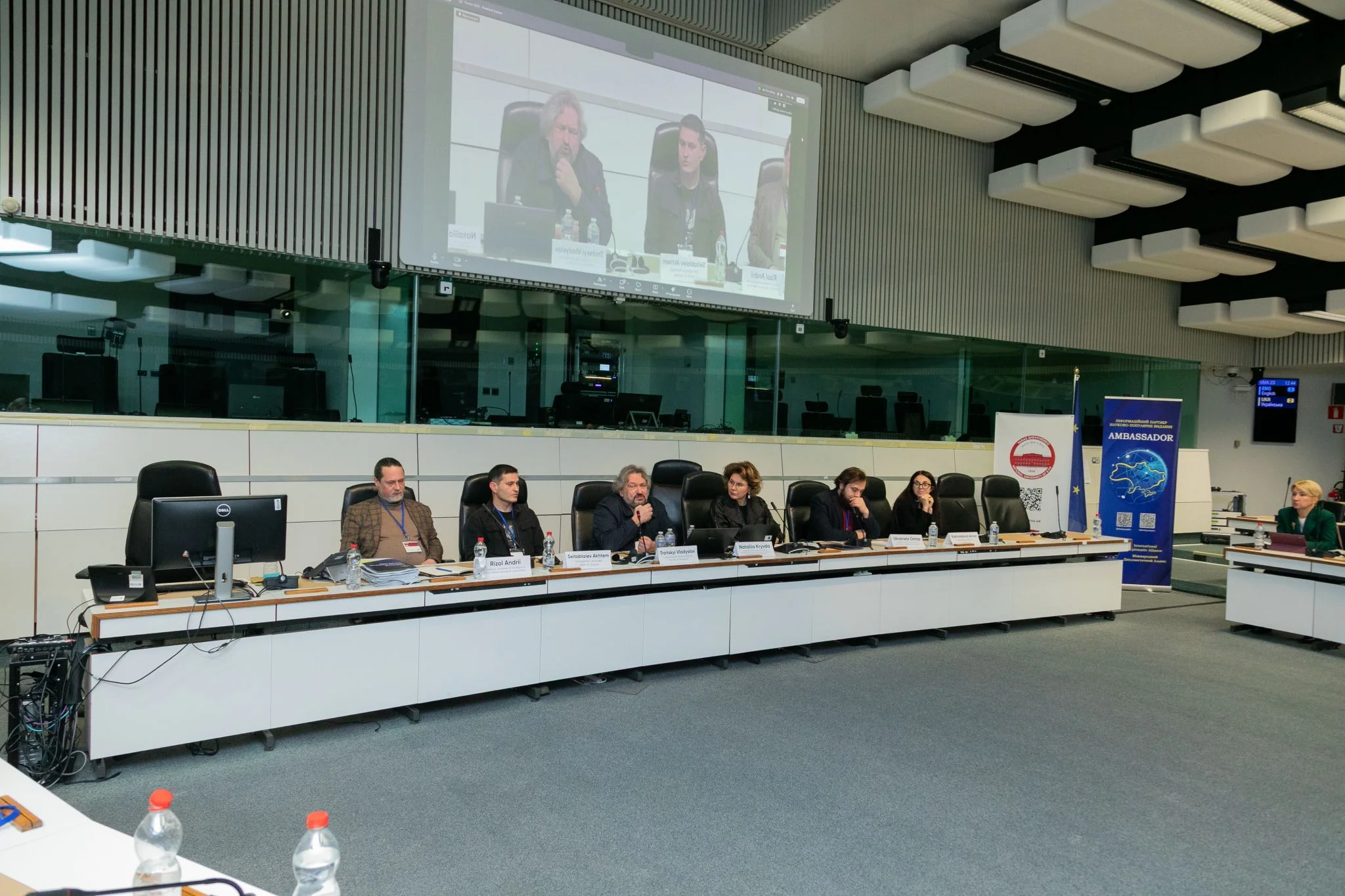
NGO LingvaLexa Joined the Discussion at the EESC on Countering Russian Propaganda and Disinformation
A professional discussion was held at the European Economic and Social Committee (EESC) as part of the forum “Resilient Europe: Countering Russian Propaganda and Disinformation.” The event was organized by the Institute of National Resilience and Security, the Research Institute of Ukrainian Studies of Taras Shevchenko National University of Kyiv, and the NGO VZW Ukraine.
During the discussion, the Head of NGO LingvaLexa Anna Vyshniakova, together with representatives of the above-mentioned organizations, examined the anatomy of Russian influence within the European Union and its implications for democratic resilience.
Participants emphasized that the information battle is not confined to media narratives alone. The aggressor has transformed the concept of “soft power” into a weapon, relying on institutions presented as cultural or religious actors. In particular, Rossotrudnichestvo and the Russian Orthodox Church were identified as instruments of influence used to enable deep and systematic penetration into European societies.
An analysis of the information space in France, Spain, Belgium, and Hungary, conducted within the framework of the study “Strategic Resilience in Conditions of Hybrid Influence: Review of Expert Recommendations and Strategic Implications” by the Institute for National Resilience and Security, revealed a notable shift in narratives and the increasing use of manipulative tactics on the European stage. These efforts aim to obscure military intentions and reframe public debate. In particular, hostile propaganda actively promotes the claim that support for Ukraine allegedly harms the EU economy - an attempt to undermine European unity by exploiting social and economic discontent.
The discussion further underlined that merely refuting disinformation is no longer sufficient. Europe is moving from a situational response to individual falsehoods toward a comprehensive strategy of cognitive resilience. In this context, Ukraine’s experience in countering disinformation and the so-called “culture war” is increasingly recognized as a critical resource for strengthening the democratic resilience of the European Union as a whole.
The organizers and participants expressed their gratitude to the forum’s Executive Director, Kateryna Nastoyashcha, and the Director of the Institute for National Resilience and Security, Rena Marutyan, for initiating and facilitating this important discussion.