The Importance of Ensuring Accountability for Hate Propaganda: Anna Vyshniakova’s Address at the Assembly of States Parties of the ICC
The NGO LingvaLexa, as part of the Coalition for the International Criminal Court, consistently emphasizes the need to address the role of propaganda in the context of armed conflicts not only within academic or public discourse, but also on international legal platforms, in particular within the framework of the International Criminal Court.
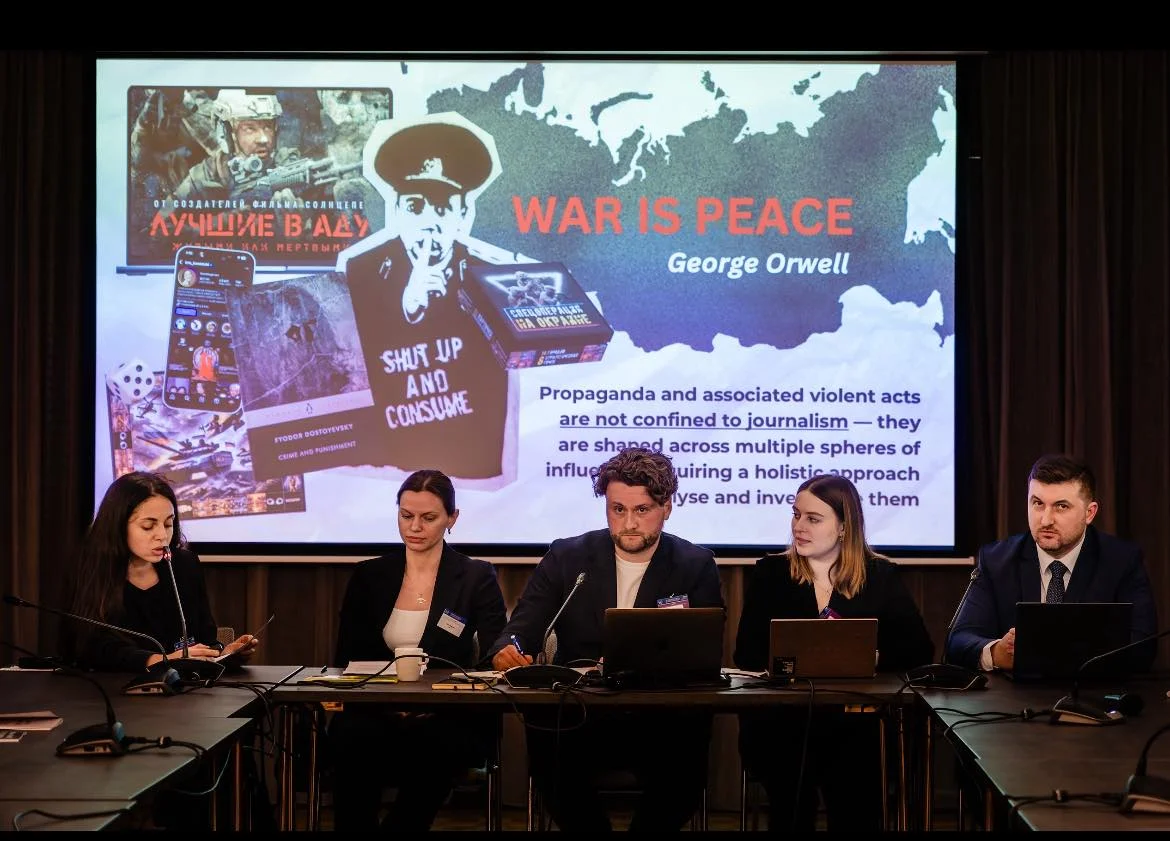
As part of the 24th Session of the Assembly of States Parties to the International Criminal Court (ASP24), NGO LingvaLexa, in partnership with the Office of the Prosecutor General of Ukraine, the Platform for Peace and Humanity, and jointly with the NGO Social Action Center and the International Federation for Human Rights, organized a side event.
The Head of the Organization, Anna Vyshniakova, delivered a presentation dedicated to propaganda as a systemic element of international crimes. She opened her speech with the phrase, “In the beginning was the word,” emphasizing that propaganda constitutes the foundation of aggressive war, without which mass violence could neither be motivated, justified, nor rendered socially acceptable.
The speech stressed that crimes related to propaganda must not be treated as secondary or as issues that do not require an immediate response. Despite the complexity of investigating such crimes and the absence of instantly visible consequences, propaganda is precisely what creates an environment in which atrocities become possible, normalized, and repeatedly reproduced. It is the sine qua non of aggressive war—an instrument that systematically destroys legal and moral reality.
Special attention was given to the necessity of a comprehensive approach to accountability for such crimes. Propaganda cannot be reduced solely to journalism or political statements. It permeates various spheres of life—from education, culture, and sports to video games, social media, cinema, and literature—immersing audiences in a closed informational “bubble” that shapes a distorted perception of reality. In the context of rapid technological development, the law must adapt to new scales and speeds of influence rather than remain constrained by conservative approaches.
Anna Vyshniakova also emphasized that those who must bear responsibility for propaganda are not limited to public figures appearing on television screens or in newspaper headlines. Effective criminal prosecution requires the construction of a full chain of responsibility, encompassing editors, producers, media executives, and individuals who finance and coordinate propaganda campaigns, with this chain being traced directly to the political decision-making center in the Kremlin.
The transboundary nature of propaganda was highlighted separately. Unlike missiles, propaganda does not stop at Ukraine’s borders but spreads far beyond them, influencing societies in other states. For this reason, international cooperation, the use of mechanisms of universal jurisdiction, sanctions, and other instruments of international law are critically important for effectively countering such crimes.
In conclusion, Anna emphasized that the international community has already missed the stage of prevention, and that today it is imperative to immediately strengthen consolidated efforts to counter the systemic lies and disinformation disseminated by the Kremlin.
The NGO LingvaLexa, together with law enforcement authorities, will continue its work aimed at ensuring accountability for crimes related to propaganda as an integral component of contemporary international crimes.