From Battlefield Effect to Accountability: LingvaLexa at #Disinfo2026
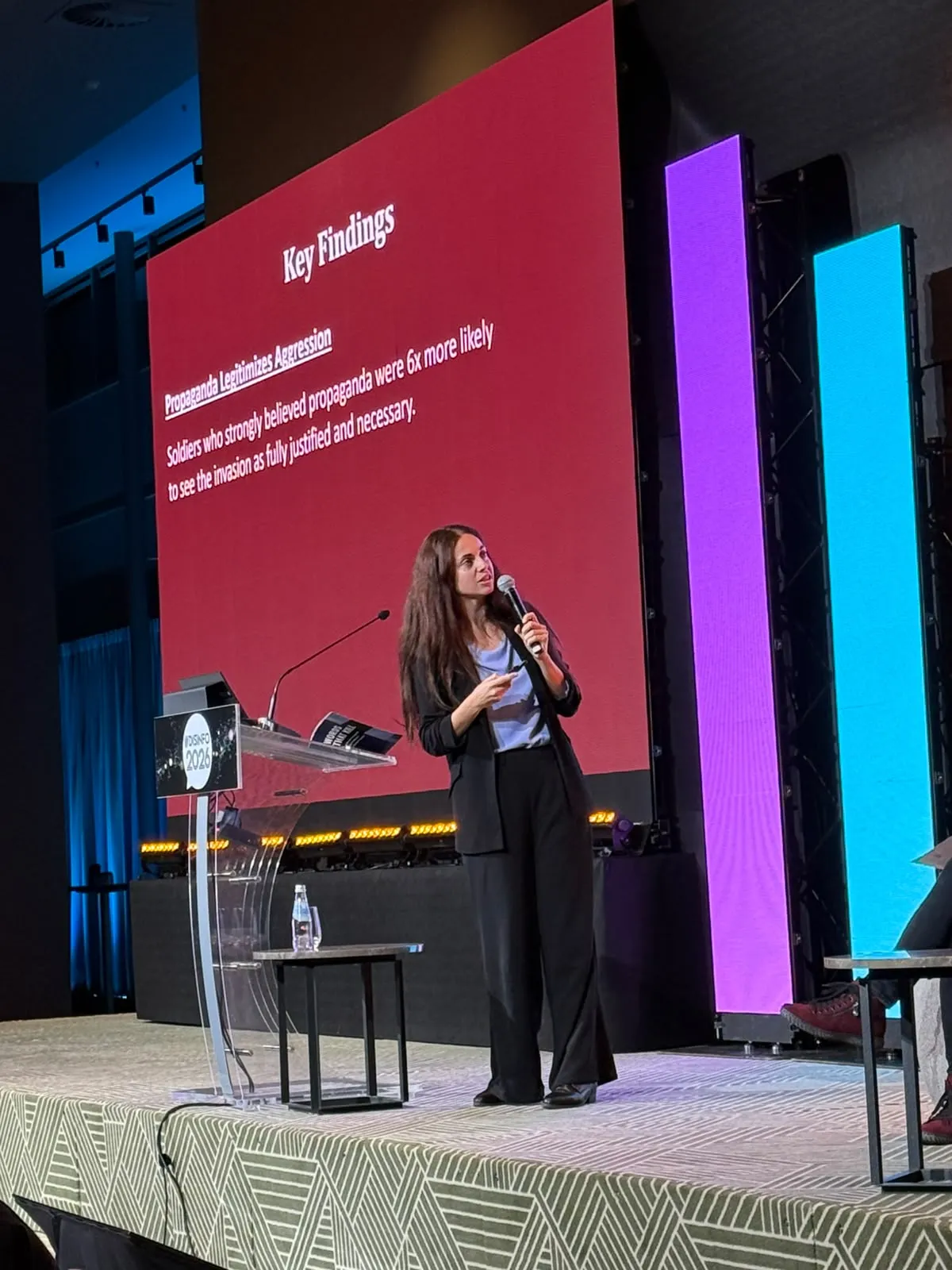
On 7 October, Anna Vyshniakova, Head of LingvaLexa, spoke at #Disinfo2026 in Vilnius, the annual conference of EU DisinfoLab.
In her presentation, “From Battlefield Effect to Accountability: Prosecuting War Propaganda,” Anna examined propaganda not simply as a rhetorical phenomenon, but as a measurable factor influencing battlefield behaviour and, when properly documented, as a potential source of evidence for accountability and justice.
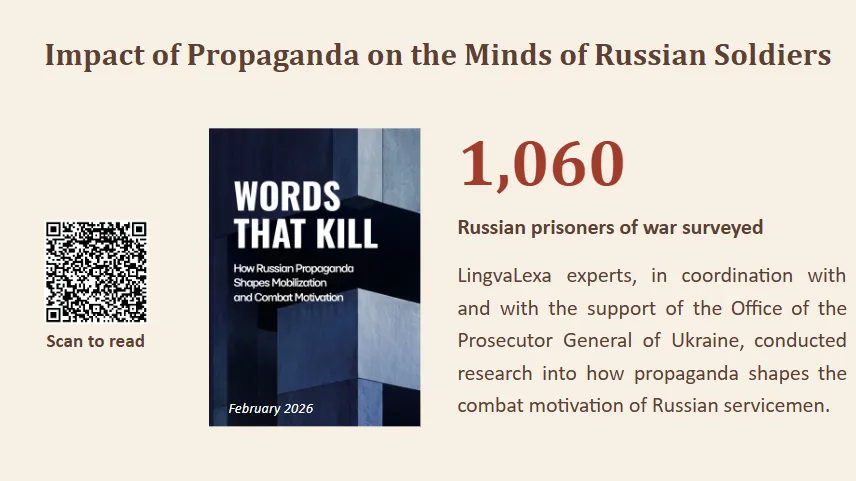
The presentation drew on LingvaLexa’s research conducted in coordination with and with the support of the Office of the Prosecutor General of Ukraine. The study surveyed 1,060 Russian prisoners of war and examined how belief in propagandist narratives relates to perceptions of the legitimacy of Russia’s aggression, ideological identification, dehumanisation of Ukrainians and willingness to return to combat.
The findings showed a clear relationship between stronger belief in propagandist narratives and attitudes relevant to continued participation in the war. Respondents with stronger belief in the narratives examined were significantly more likely to view Russia’s invasion as fully justified or necessary. The research also identified links between stronger belief in propaganda and deeper ideological identification, greater prevalence of dehumanising attitudes towards Ukrainians, and a greater willingness to return to combat.
But establishing the effects of propaganda is only one part of the challenge.
The second part of the presentation focused on what happens once relevant information has been collected and verified. Research can contribute to identifying patterns and understanding the mechanisms through which propaganda operates. The next question is how such findings can inform investigations and how evidence can ultimately be connected to accountability and justice mechanisms.
This requires looking at propaganda not as a series of isolated statements, but as part of a broader system. Research, investigation, disruption, litigation and institutional reform can each play a role, while no single mechanism is sufficient on its own.
The presentation also addressed a longer-term consequence of information warfare: the erosion of trust in evidence itself. When information is deliberately manipulated on a large scale, the challenge for international justice is not only to establish what happened, but also to preserve confidence in the evidence used to establish it.
For LingvaLexa, this connection between empirical research, legal analysis and accountability is central to our work. The discussion in Vilnius provided an opportunity to share the Ukrainian experience and exchange perspectives with researchers, practitioners, policymakers and civil society organisations working on disinformation, information warfare and accountability.