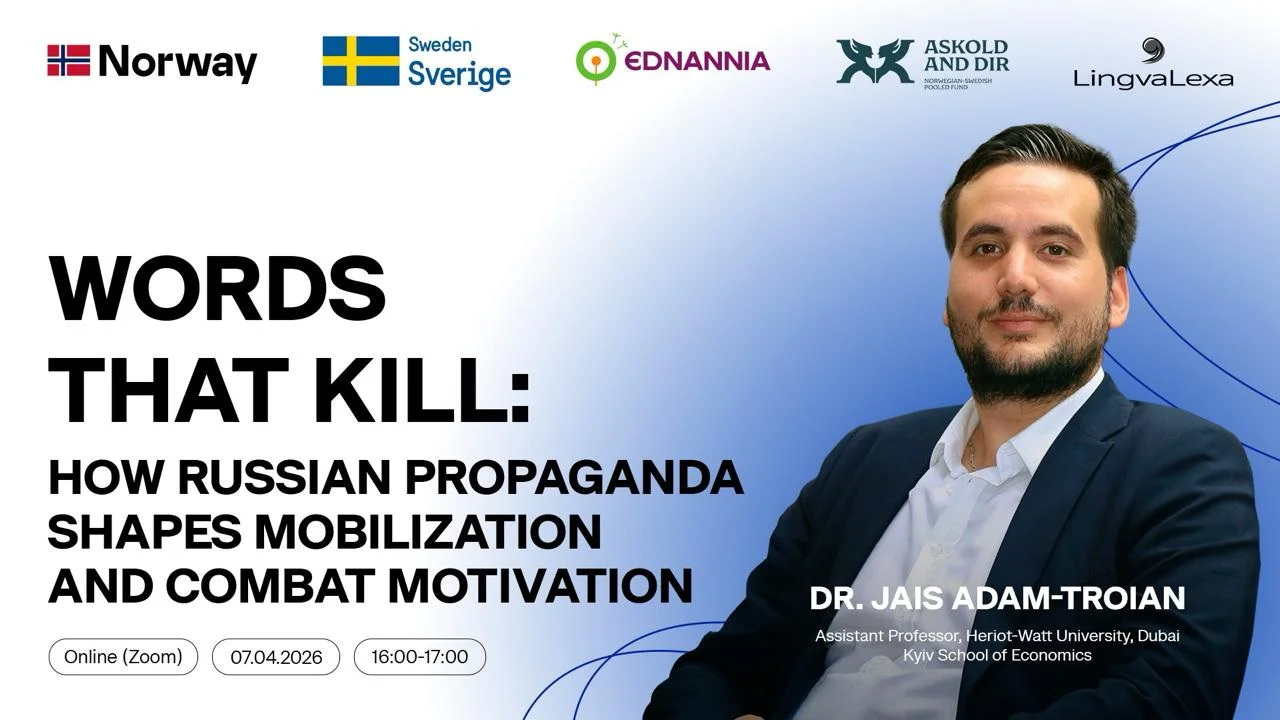
Online presentation of the research “Words that Kill: How Russian Propaganda Shapes Mobilization and Combat Motivation” in the Kyiv School of Economics
As part of the advocacy campaign conducted by NGO LingvaLexa, an online presentation of the research “Words that Kill: How Russian Propaganda Shapes Mobilization and Combat Motivation” was held on April 7. The research focuses on the impact of Russian propaganda on mobilization and combat motivation.
The event was produced with the support of the Askold and Dir Fund as part of the “Strong Civil Society of Ukraine – a Driver towards Reforms and Democracy” project, implemented by ISAR Ednannia and funded by Norway and Sweden. The event was co-organised with the Kyiv School of Economics.
The event brought together researchers, legal professionals, and practitioners working at the intersection of international law, social psychology, and countering disinformation.
The research, based on a survey of 1,060 Russian prisoners of war, shows that perceived legitimacy of the war plays a key role in shaping combat motivation. At the same time, ideological attitudes and dehumanisation, while having some effect, appear to be less decisive once the factor of perceived legitimacy is taken into account. This suggests that propaganda operates not only through hate speech or ideology, but also by shaping perceptions of the war as justified and necessary.
During the presentation, Jais Adam-Troian, Assistant Professor of Psychology at Heriot-Watt University Dubai and researcher at the NATO Strategic Communications Centre of Excellence, emphasised that propaganda functions as a systemic tool of influence aimed at shaping perceptions and behavioural dispositions. At the same time, he noted that its effects are not absolute and depend on the broader social and psychological context.
Particular attention was paid to the practical implications of the study. Among the possible approaches to countering propaganda, the discussion highlighted debunking, the development of counter-narratives, and the use of behaviour change tools. At the same time, as Anna Vyshniakova, Head of NGO LingvaLexa, emphasised, the findings underline that effective countering of propaganda requires systematic and long-term efforts, combining research, practical interventions, and interdisciplinary cooperation.